
Every July, the most famous avenue in Paris stops being a place for traffic and shopping and turns into a stage for samba, zouk and drumming. The Carnaval Tropical de Paris is a free, open-air parade that rolls down the Champs-Élysées with thousands of dancers and musicians in feathers, sequins, masks and enormous sculptural costumes. Some come from French overseas territories such as Guadeloupe, Martinique, French Guiana and Réunion, others from Brazil, Colombia, the Andes and beyond. Because the parade follows one of the city’s best-known routes, the show comes with a backdrop that no other carnival can match: the Arc de Triomphe at one end, the trees of the avenue overhead and Haussmann facades on both sides. If you are visiting Paris in early summer and want something lively that costs nothing, this is one of the easiest and most colourful events to add to your trip. Below you will find what the carnival is, who takes part, where to stand, and how to avoid the crowd mistakes that first-timers often make.
Plan Your Paris Trip in 60 Seconds!
Get a personalized itinerary created by locals in 60 seconds. We’ll tell you the best time to visit, hidden viewpoints, and how to avoid crowds.
The carnival is organised by the City of Paris together with the Fédération du Carnaval Tropical de Paris, and it usually takes place on a Sunday in the first days of July, in the afternoon. The exact date and the yearly theme change, so always check the official event page before you go. Everything in this guide is meant to stay useful from one year to the next.
🇨🇵 Carnaval Tropical | Champs-Élysées Paris
🎭 What Is the Carnaval Tropical de Paris?
The Carnaval Tropical de Paris has been held since 2001, created to bring a large tropical parade to the French capital and to celebrate the richness of overseas and world cultures. It is organised by the City of Paris with the Fédération du Carnaval Tropical de Paris, a federation that brings together the groups taking part. According to the City of Paris event page, each edition has its own theme, often built around the idea of the world’s cultures meeting in one city.
The numbers explain why it feels so big. Tourism sources such as Paris Je t’aime mention more than 4,000 dancers and musicians and around a dozen floats, and the parade is said to draw roughly 200,000 spectators along the route. Entry is free and open to everyone, so you can watch for ten minutes or for the whole afternoon.

💃 Costumes, Feathers and Rhythms to Look For
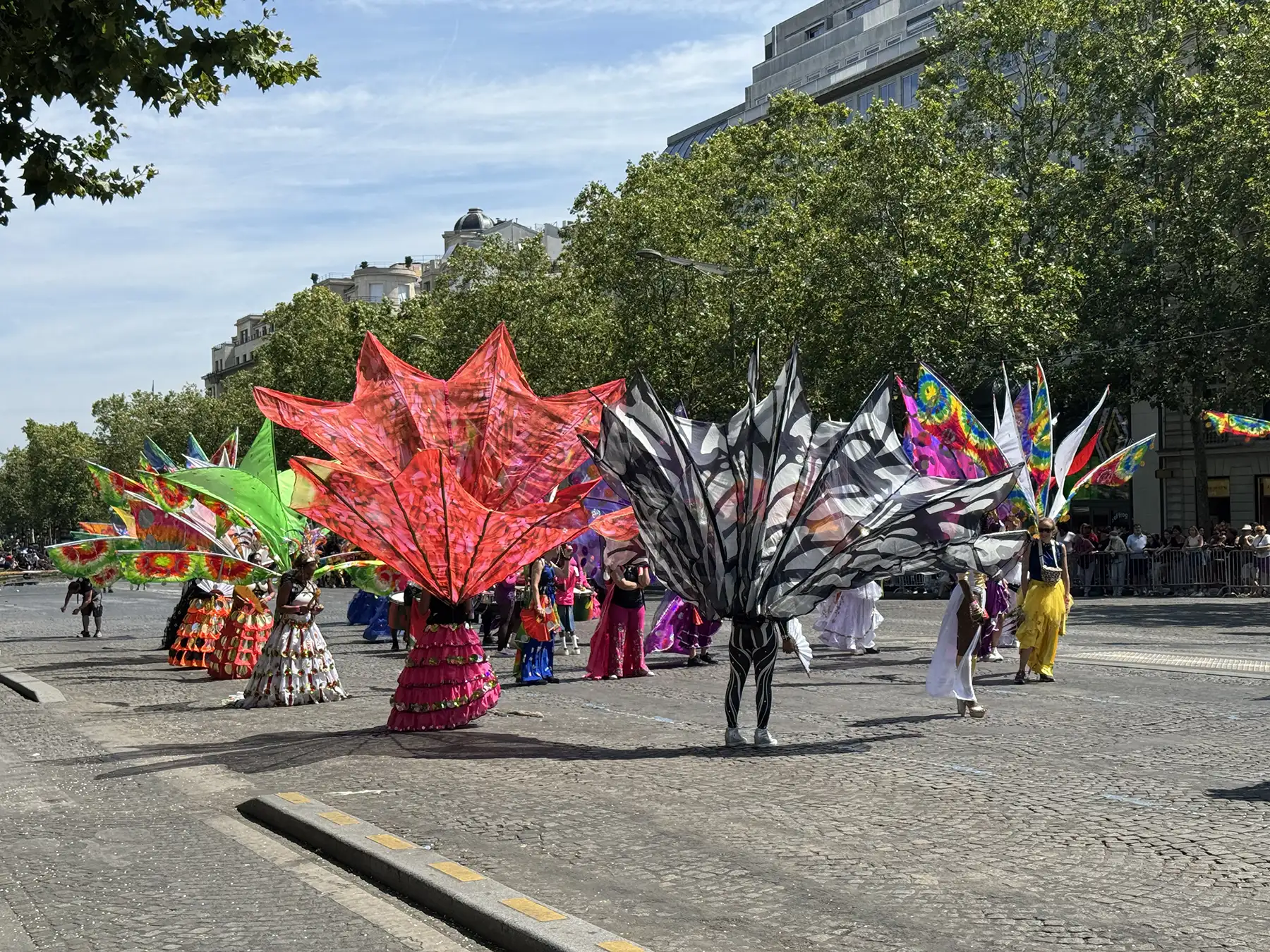
The first thing you notice is colour. Feathered headdresses in rainbow shades, beaded costumes, glittering bodices and giant fan-shaped wings that rise higher than the dancers themselves all move down the avenue at once. Some costumes look like living sculptures, with huge wings that open and close as the performer turns, and they make the avenue look like a moving garden.
The music is just as varied. Depending on the year, you can hear zouk, samba, compas, salsa and gwoka, and many groups bring their own drummers so the rhythm changes every few metres. Do not worry about knowing the names: the easiest approach is to pick a spot, stay put for a while and let each group introduce itself as it passes.
🗺️ Where to Watch: Route and Best Spots
The parade follows the Champs-Élysées from the Arc de Triomphe towards Place de la Concorde, ending with a finale near the Grand Palais and the Petit Palais on Avenue Winston Churchill. The avenue is wide and mostly flat, so you can choose how close to get.
- Near the Arc de Triomphe: the start of the route, with the freshest energy and the most photogenic backdrop. It also gets the thickest crowds early on.
- Middle of the avenue: the best balance. Metro stops such as George V and Franklin D. Roosevelt are close, and cafés and shop awnings offer a little shade.
- Towards the Grand Palais and Petit Palais: usually a little less packed, and good if you want to combine the parade with a museum visit or a stroll in the nearby Tuileries Garden.
The official Arc de Triomphe website is useful if you also want to climb to the rooftop viewpoint on the same day. Arrive at least an hour early for a front-row place behind the barriers, and expect some streets around the avenue to be closed to traffic.
🥁 Drums, Masks and Folk Traditions
Some of the most striking moments come from traditional troupes rather than from the feathered samba groups. Look for dancers in full masks and heavy embroidered costumes, drummers in matching plaid skirts, and groups that gather in a tight circle before they move off together. Several of them wear or carry the colours of their home country, and one drum in the parade even carried the words Paris and Bolivia. These folk groups often dance for much longer stretches without a break, so they are great for video.
If you like taking photos, a short telephoto lens or the zoom on your phone helps you capture faces and costume details without pushing through the crowd.


🌍 Many Cultures, One Avenue
What makes the Carnaval Tropical special is the mix. In the same hour you can see groups connected to Guadeloupe, Martinique, French Guiana, Réunion, Brazil, Colombia, Peru, Bolivia, Haiti, Cape Verde and more, sharing one stretch of tarmac. Some groups dance in layered, swirling skirts in dark tones or bright orange, in styles that look closer to Andean folk dance than to Rio-style samba.
The parade is not a stage show behind a fence, either. Spectators clap, sing and dance along from the pavement, and the mood stays friendly and relaxed. For travellers it is a quick, free way to feel the diversity of France beyond the usual museums.


✅ Practical Tips for Visiting
Some performances are choreographed show pieces, others are looser street dances where the performers stop, kneel or pose for the public, so keep your camera ready. A few practical points will make the day easier:
- Check the official page first. The City of Paris publishes the date, schedule and theme every year. Both Paris.fr and Paris Je t’aime list it.
- Take the metro. The best-served stations are Charles de Gaulle – Étoile (lines 1, 2, 6 and RER A), George V (line 1), Franklin D. Roosevelt (lines 1 and 9) and Concorde (lines 1, 8 and 12). Do not plan to drive or park nearby.
- Dress for summer sun. The avenue has partial shade at best. Bring water, sunscreen and a hat, and wear comfortable shoes.
- Keep your belongings close. Large crowds attract pickpockets, so use a zipped bag worn at the front.
- Read a little more before you go. Detailed guides such as Paris ZigZag and Festival en France give extra background.